What Are Transition Services?
Transition services as defined by P.L. 101-476:
A coordinated set of activities designed within an outcome oriented process that promotes movement from school to post-school activities including:
- Post – secondary education
- Vocational training
- Integrated employment (including supported employment)
- Continuing and adult education
- Adult services
- Independent living or community participation
The coordinated set of activities must be based on the individual student's needs, taking into account the student's preferences, including:
- Instruction
- Community experiences
- Development of employment and other post-school adult living objectives and if appropriate:
- The acquisition of daily living skills and functional vocational evaluation
Why Is Transition Needed?
Transition Services are needed for youth with disabilities to become well-adjusted, suitably employed members of their communities. Planning ahead helps students and families connect with the supports, training, and services they will rely on as adults.
Transition Can Help
It can help by:
- Improving access to agencies and services
- Improving communication among students, family members, service providers, business and other community supports.
- Reducing gaps in service delivery and availability.
- Limiting duplication of services or efforts.
- Creating new programs and services where needs are not being met.
- Preparing students for the responsibilities and rewards of adult living and participation in the community.
What Will Transition Do?
Prepare students with disabilities for the world of work by providing the following services:
- Career education
- Vocational evaluations
- Job training
- Teaching work behaviors
- Planning for college or vocational school
- Financial aid
Prepare students for adult living:
- Teach daily living skills
- Housing choices
- Assist with transportation
- Financial support
- Leisure activities
How Do We Get There?
- Teamwork with families, agencies, businesses and school
- Helping people help themselves
(self-advocacy skills)
- Person-centered planning
- Educating the schools, businesses, and agencies about transition
- Developing materials and tools to help people with transition planning
Past Program Highlight: Artist in Residence
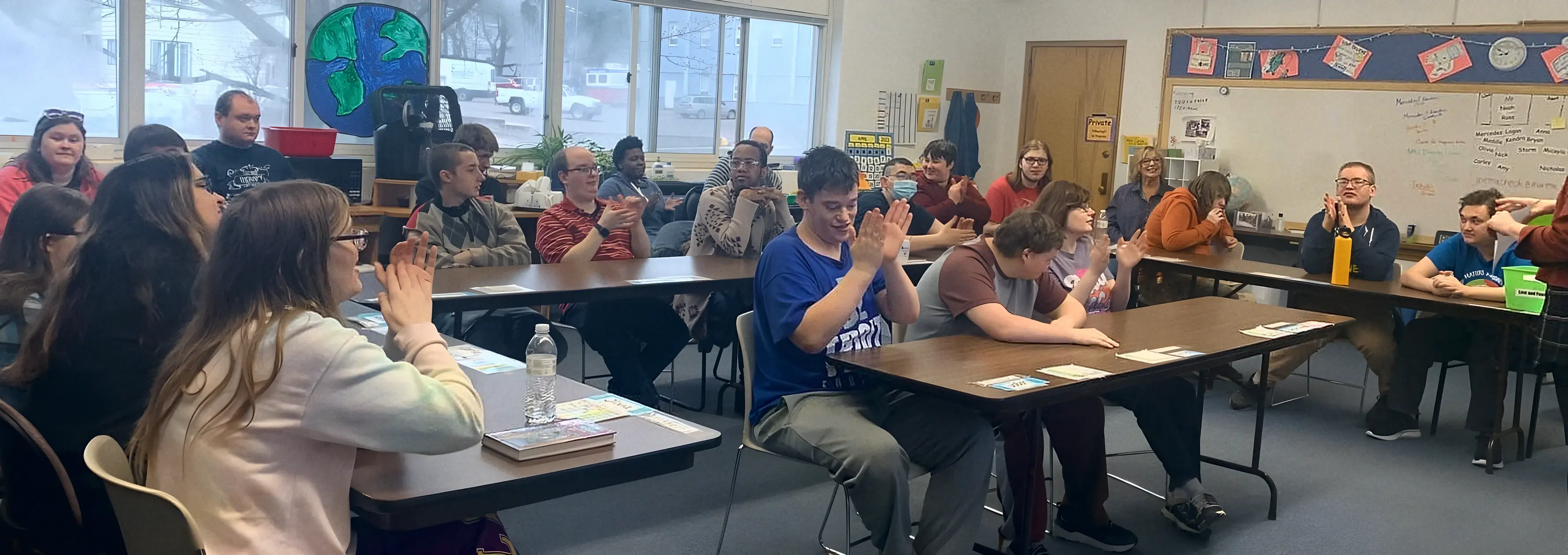
During the 2017–2018 school year, the Very Special Arts “Artist in Residence” grant project brought creative dance, music, and storytelling experiences to four Marquette-Alger RESA classrooms in Marquette County, including two center-based Transition programs for students aged 18-26. Local professional artists — including members of the TaMaMa Dance Company, musician and storyteller Corinne Rockow, and percussionist Carrie Biolo — connected the arts with the academic curriculum and students' IEP (Individual Education Plan) goals, and shared strategies with classroom teachers and paraprofessionals for using movement, music, and story making to teach other curricular subjects and life skills.
Resources
Transition II Program Brochure
Transition Program Studio "T" Brochure
A to Z of Disabilities and Accommodations (opens in new tab)
Partner for Youth with Disabilities (opens in new tab)
Michigan Rehabilitation Services (opens in new tab)
Classroom Teachers
Alicia Garwood, Transition I – located at St. Michael's
Dawn Broxholm-Pape, Transition II – located at St. Michael's
Paul Trdan, Great Lakes Recovery Center
Christopher Conchola, Teaching Family Homes
Classroom Aides
Kyle Rollins, Transition 1
Kathryn Forgette, Transition 1
Jill Mielcarek, Transition 1
Melissa Kauppi, Transition II
Sara McDonald, Transition II
Natasha Cheyne, Superior Shores
Melissa Peterson, Superior Shores